

Dr Jekyll És Mr Hyde Film
| Dr. Jekyll and Mr. Hyde | |
|---|---|
 Theatrical release poster | |
| Directed by | Rouben Mamoulian |
| Screenplay past | Samuel Hoffenstein Percy Heath |
| Based on | The Strange Example of Dr Jekyll and Mr Hyde (1886 novella) by Robert Louis Stevenson |
| Produced by | Rouben Mamoulian |
| Starring | Fredric March Miriam Hopkins Rose Hobart |
| Cinematography | Karl Struss |
| Edited by | William Shea |
| Music by | Johann Sebastian Bach (uncredited) Herman Hand (adaptor – uncredited) |
| Production | Paramount Pictures |
| Distributed by | Paramount Pictures |
| Release dates |
|
| Running time | 98 minutes |
| Country | United States |
| Language | English language |
| Budget | $535,000[1] |
| Box office | $i,300,000 (rentals)[ii] |

Dr. Jekyll and Mr. Hyde is a 1931 American pre-Code horror film, directed by Rouben Mamoulian and starring Fredric March, who plays a possessed doctor who tests his new formula that tin can unleash people's inner demons. The motion-picture show is an adaptation of The Strange Case of Dr Jekyll and Mr Hyde, the 1886 Robert Louis Stevenson tale of a man who takes a potion which turns him from a mild-mannered man of science into a homicidal maniac.
The film was a critical and commercial success upon its release. Nominated for iii Academy Awards, March won the honour for Best Thespian, sharing the honor with Wallace Beery for The Champ.
Plot [edit]
Dr. Henry Jekyll (Fredric March), a kind English doctor in Victorian London, is sure that within each man lurks impulses for both good and evil. He is desperately in honey with his fiancée Muriel Carew (Rose Hobart) and wants to marry her immediately. But her father, Brigadier General Sir Danvers Carew (Halliwell Hobbes), orders them to wait. One nighttime, while walking home with his colleague, Dr. John Lanyon (Holmes Herbert), Jekyll spots a bar vocalist, Ivy Pierson (Miriam Hopkins), being attacked by a man exterior her boarding house. Jekyll drives the man away and carries Ivy up to her room to nourish to her. Ivy tries to seduce Jekyll but, though he is tempted, he leaves with Lanyon.
When Sir Danvers takes Muriel to Bath, Jekyll begins to experiment with drugs that he believes will unleash his evil side. After imbibing a concoction of these drugs, he transforms into Edward Hyde—an impulsive, sadistic, violent, amoral man who indulges his every desire. Hyde finds Ivy in the music hall where she works. He offers to financially support her in render for her visitor. They stay at her boarding house where Hyde rapes and psychologically manipulates her. When Hyde reads in the paper that Sir Danvers and Muriel are planning to return to London, Hyde leaves Ivy simply threatens her that he'll return when she least expects it.
Overcome with guilt, Jekyll sends £50 to Ivy. On the advice of her landlady, Ivy goes to meet Dr. Jekyll and recognizes him as the man who saved her from abuse that night. She tearfully tells him about her situation with Hyde, and Jekyll reassures her that she volition never see Hyde over again. Only the next nighttime, while walking to a party at Muriel'south where the wedding ceremony engagement is to be announced, Jekyll spontaneously changes into Hyde. Rather than attend the party, Hyde goes to Ivy's room and murders her.
Hyde returns to Jekyll's house but is refused access by the butler. Desperate, Hyde writes a letter to Lanyon instructing him to take sure chemicals from Jekyll's laboratory and have them home. When Hyde arrives, Lanyon pulls a gun on him and demands that Hyde take him to Jekyll. With no other pick, Hyde drinks the formula and changes dorsum into Jekyll before a shocked Lanyon.
Enlightened that he cannot control the transformations, Jekyll goes to the Carew abode and breaks off the engagement. After he leaves, he stands on the terrace and watches Muriel cry. This triggers another transformation and, as Hyde, he enters the firm and assaults Muriel. Sir Danvers tries to end him, but Hyde beats him to death with Jekyll's walking stick then flees back to Jekyll's laboratory where he takes the formula once more and reverts to Jekyll.
Lanyon recognizes the broken cane left at the criminal offense scene and takes the constabulary to Jekyll's dwelling house. Jekyll tells them that Hyde has already left, Lanyon insists that Jekyll and Hyde are one and the aforementioned. The stress causes another transformation into Hyde and, afterwards a violent struggle, Hyde is shot past the police. Dying, he transforms back into Jekyll.
Cast [edit]
- Fredric March as Dr. Henry Jekyll / Mr. Edward Hyde
- Miriam Hopkins every bit Ivy Pierson
- Rose Hobart as Muriel Carew
- Holmes Herbert as Dr. John Lanyon
- Halliwell Hobbes as Brigadier-Full general Danvers Carew
- Edgar Norton as Poole
- Tempe Pigott as Mrs. Hawkins
- Arnold Lucy every bit Utterson (uncredited)
- Colonel McDonnell equally Hobson (uncredited)
Source:[3]
Production [edit]
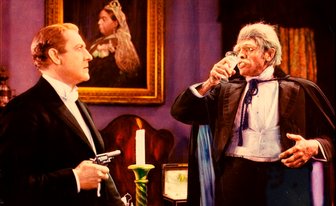
The picture was fabricated prior to the total enforcement of the Production Code and is remembered today for its potent sexual content, embodied mostly in the grapheme of the bar singer, Ivy Pierson, played past Miriam Hopkins. When it was re-released in 1936, the Code required viii minutes to be removed before the moving picture could be distributed to theaters. This footage was restored for the VHS and DVD releases.[iv]
The undercover of the transformation scenes was not revealed for decades (Mamoulian himself revealed it in a volume of interviews with Hollywood directors published under the title The Celluloid Muse). Make-up was applied in contrasting colors. A series of colored filters that matched the make-up was then used which enabled the make-up to be gradually exposed or fabricated invisible. The change in color was non visible on the blackness-and-white motion-picture show.[v]
Wally Westmore'due south brand-up for Hyde — simian and hairy with large canine teeth — influenced profoundly the popular epitome of Hyde in media and comic books. In part this reflected the novella's implication of Hyde equally embodying repressed evil, and hence beingness semi-evolved or simian in advent. The characters of Muriel Carew and Ivy Pierson exercise non appear in Stevenson'south original story; Ivy Pierson'due south character is original to the movie, while Muriel [Agnes] Carew does appear in the 1887 stage version past playwright Thomas Russell Sullivan.
John Barrymore was originally asked by Paramount to play the lead role, in an attempt to recreate his role from the 1920 version of Jekyll and Hyde, but he was already under a new contract with Metro-Goldwyn-Mayer. Paramount then gave the part to March, who was under contract and who bore a physical resemblance to Barrymore. March had played a John Barrymore-similar graphic symbol in the Paramount film The Royal Family of Broadway (1930), a story about an acting family similar to the Barrymores. March, following stage tradition, overplayed both Jekyll and Hyde to emphasize their contrasts[6] and would go along to win the Academy Laurels for Best Actor for his performance of the role.[5]
When Metro-Goldwyn-Mayer remade the pic x years afterward with Spencer Tracy in the lead, the studio bought the negative and the rights to both the Mamoulian version and the earlier 1920 silent version, paying $1,250,000. Every print of the 1931 film that could be located was recalled and destroyed, and for decades, the moving picture was believed lost.[seven] The Tracy version was much less well received and March jokingly sent Tracy a telegram thanking him for the greatest boost to his reputation of his entire career.
The opening credits use Toccata and Fugue in D minor, BWV 565 by Johann Sebastian Bach.[8]
Reception [edit]
Box office [edit]
Dr. Jekyll and Mr. Hyde premiered in Los Angeles on December 24, 1931 and opened in New York Urban center on December 31, 1931. Grossing $1.three million in domestic rentals,[2] the film was a box office hitting on par with the Universal monster films of the era, even considering that its $535,000 budget was loftier for a horror film at the fourth dimension.[1]
Critical reception [edit]
Dr. Jekyll and Mr. Hyde received mostly positive reviews upon its release. Mordaunt Hall of The New York Times wrote an enthusiastic review, comparing it favorably to the John Barrymore version every bit a "far more than tense and shuddering affair" than that flick. Hall called March "the stellar performer" in the title function while praising the acting of the unabridged supporting bandage as well, and chosen the old-fashioned atmosphere created by the costumes and set designs "quite pleasing".[9]
Motion-picture show critic Leonard Maltin gave the film 3 out of a possible 4 stars, calling it "exciting", and "floridly cinematic", also praising March's and Hopkins performances.[x]
Variety ran a somewhat less favorable only still positive review. Alfred Rushford Greason wrote that "the pic doesn't build to an effective climax" because it was as well slow and labored in getting at that place, and that while the initial transformation sequence "carries a terrific punch", its upshot became lessened with successive uses. All the same, Greason credited March with "an outstanding bit of theatrical acting", declared the makeup "a triumph", and said that the sets and lighting lonely made the film worth seeing "as models of atmospheric surroundings."[eleven]
John Mosher of The New Yorker reported that the pic "has its full storage of horror" and was "well acted". March, he wrote, "gives usa a Mr. Hyde as athletic and exuberant every bit might accept been that of Douglas Fairbanks, Senior."[12] Moving-picture show Daily alleged: "Gripping performance by Fredric March is highlight of strong drama, ace supporting bandage and direction".[13]
Picture review aggregator Rotten Tomatoes reported an approval rating of xc%, based on 40 reviews, with a rating average of viii.27/ten. The site's critical consensus reads, "A classic. The definitive version of the Robert Louis Stevenson novella from 1931, with innovative special effects, atmospheric cinematography and deranged overacting."[14]
Awards and honors [edit]
Wins
- University Awards: Oscar; Best Histrion in a Leading Role, Fredric March; tied with Wallace Beery for The Gnaw; 1932.
- Venice Film Festival: Audience Referendum; Well-nigh Favorite Thespian, Fredric March; Nearly Original Fantasy Story, Rouben Mamoulian; 1932.
- Film Daily: 10 Best Films
- The New York Times: 10 Best Films
Nominations
- Academy Awards: Oscar; Best Adaptation Writing, Percy Heath and Samuel Hoffenstein; 1932; Best Cinematography, Karl Struss.
-
- Source:[fifteen]
Other honors
The picture is recognized by American Film Establish in these lists:
- 2001: AFI's 100 Years...100 Thrills – Nominated[sixteen]
- 2003: AFI's 100 Years...100 Heroes & Villains:
- Mr. Hyde – Nominated Villain[17]
Remake [edit]
Dr. Jekyll and Mr. Hyde (1941) is a remake of this film.
See also [edit]
- Gothic film
- The House That Shadows Built (1931 promotional flick past Paramount)
References [edit]
- ^ a b Hall, Sheldon; Neale, Steve (2010). Epics, Spectacles and Blockbusters. Detroit: Wayne State University Press. p. 100. ISBN978-0-8143-3008-ane.
- ^ a b Finler, Joel Waldo (2003). The Hollywood Story. Wallflower Press. pp. 356–357. ISBN978-ane-903364-66-6.
- ^ Dr. Jekyll and Mr. Hyde at the American Film Institute Catalog
- ^ Alternate versions for Dr. Jekyll and Mr. Hyde (1931)
- ^ a b Miller, Frank "Dr. Jekyll and Mr. Hyde (1931)" (commodity) TCM.com
- ^ Brottman, Mikita (2005). High Theory / Depression Culture. New York Urban center: Palgrave Macmillan. p. 117. ISBN1-4039-6640-0.
- ^ McElwee, John (February 200y7) "More on Jekyll and Hyde Greenbriar Picture Shows
- ^ Reiter, Gershon (2014). The Shadow Self in Motion picture: Projecting the Unconscious Other. p. 11. ISBN9780786476640.
- ^ Hall, Mordaunt (January 2, 1932). "Moving picture Review – Dr. Jekyll and Mr. Hyde". The New York Times . Retrieved December 7, 2014.
- ^ Maltin, Leonard; Sader, Luke; Carson, Darwyn (2013). Leonard Maltin's 2014 Movie Guide . Penguin Press. p. 390. ISBN978-0-451-41810-4.
- ^ Greason, Aldred Rushford (Jan 5, 1932). "Jekyll and Hyde". Variety. New York. p. xix.
- ^ Mosher, John (Jan 9, 1932). "The Current Movie house". The New Yorker. p. 75.
- ^ "Dr Jekyll and 60 minutes. Hyde". Film Daily. New York. January 3, 1932. p. 9.
- ^ "Dr. Jekyll and Mr. Hyde (1931) – Rotten Tomatoes". Rotten Tomatoes.com. Rotten Tomatoes. Retrieved October 24, 2016.
- ^ "Awards" All Movie Guide
- ^ "AFI's 100 Years...100 Thrills Nominees" (PDF) . Retrieved August 20, 2016.
- ^ "AFI's 100 Years...100 Heroes & Villains Nominees" (PDF) . Retrieved Baronial 20, 2016.
External links [edit]
- Dr. Jekyll and Mr. Hyde at the American Film Plant Itemize
- Dr. Jekyll and Mr. Hyde at the TCM Movie Database.
- Dr. Jekyll and Mr. Hyde at IMDb
- Dr. Jekyll and Mr. Hyde at AllMovie
- Dr. Jekyll & Mr. Hyde a Review by Walter Albert.
- Stills at the Walter Film Poster and Photo Museum
Streaming sound
- Dr. Jekyll and Mr. Hyde on Favorite Story: January 10, 1948
- Dr. Jekyll and Mr. Hyde on Theater Guild on the Air: November 19, 1950. Radio drama starring Fredric March.
- Dr. Jekyll and Mr. Hyde on Theatre Royal: January thirty, 1954
Source: https://en.wikipedia.org/wiki/Dr._Jekyll_and_Mr._Hyde_(1931_film)
Posted by: woolridgerentiold.blogspot.com
0 Response to "Dr Jekyll És Mr Hyde Film"
Post a Comment